Play Cell Eleven Solitaire Online for Free (No Signup Required)
Cell Eleven triples FreeCell to three decks: eleven cells and twelve foundations give you room to breathe, but three times the cards to untangle.
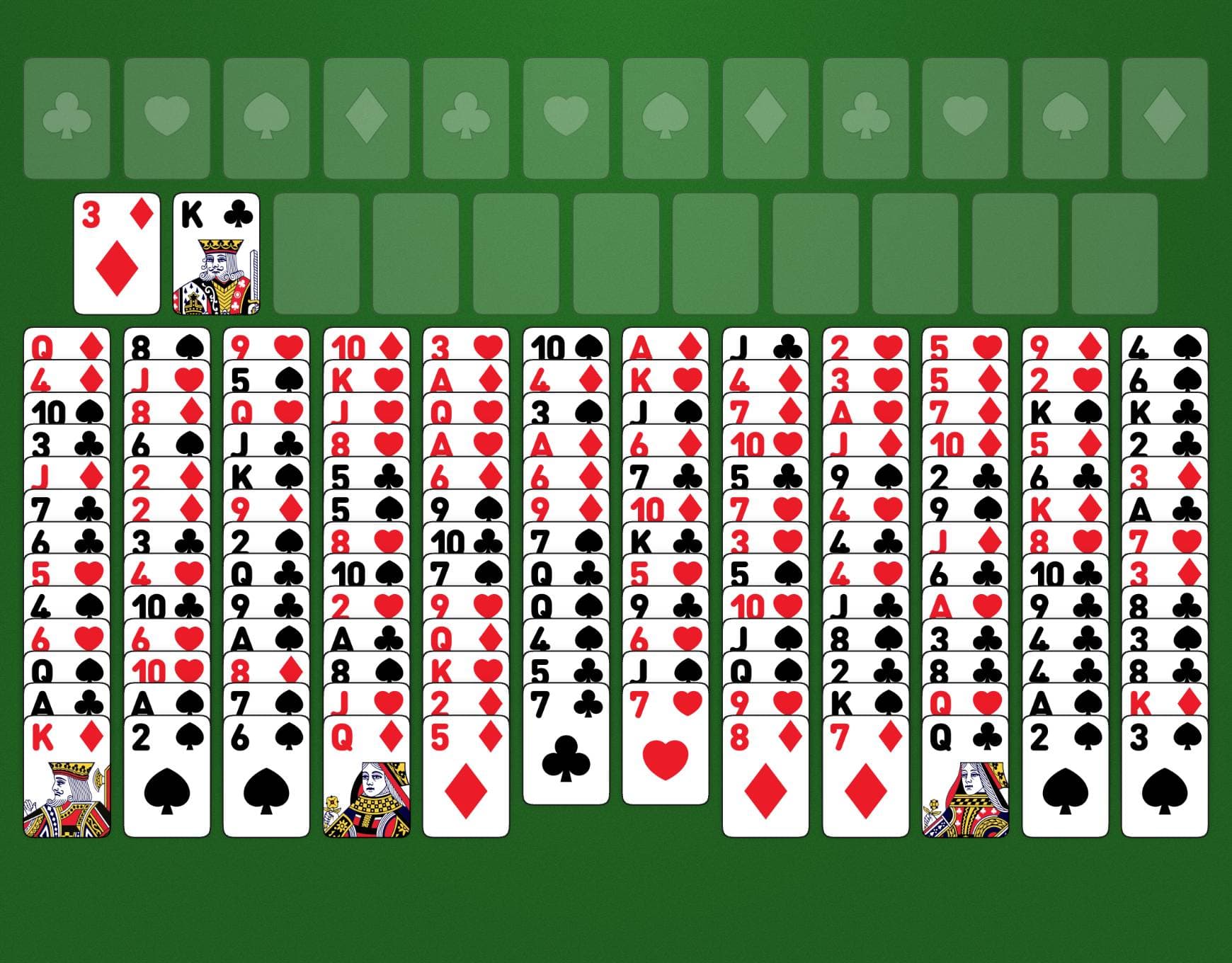
Cell Eleven Solitaire scales FreeCell up to three decks, with eleven cells instead of four and twelve foundation piles instead of four. More room to park cards means more breathing space, but three decks also means three times the cards to sort.
Triple FreeCell Solitaire and FreeCell both run on the same cell-and-foundation logic this game builds from.
If you run into anything odd or have an idea that would make the game better, please contact me.
Enjoy playing!
How to play Cell Eleven Solitaire
Foundation:
There are twelve foundation piles.
A card can be added to a foundation pile only if it's one rank higher and the same suit as the pile's current top card, so the only card that fits on a 9 of clubs is a 10 of clubs. No pile can hold more than 13 cards.
The top card of each foundation can be moved back into play if another pile will accept it.
Cells:
Eleven cells, two of which hold one card at the start of the game.
Each cell holds one card. Any available card can be played into any available cell, and cell cards can be played back to the tableau or the foundation.
Tableau:
Twelve tableau piles hold the rest of the deck, dealt face-up: ten piles get thirteen cards each, and the two middle piles get twelve cards each.
A card can be added to a tableau pile only if it's one rank lower and the opposite color of the pile's current top card, so the only cards that fit on a 7 of diamonds are the 6 of spades and 6 of clubs.
Any uncovered tableau card can be played onto the foundation, an empty cell, or another tableau pile.
Any card can fill an empty tableau slot.
Technically, only one card moves at a time, but with eleven cells and twelve columns to work with, we let you drag whole sequences whenever there's enough open space to do it one card at a time anyway.


