Play Rouge Forty Solitaire Online for Free (No Signup Required)
Rouge et Noir's staircase squared into ten neat four-card piles. Same two decks, same colors, just a tougher 15% win rate.
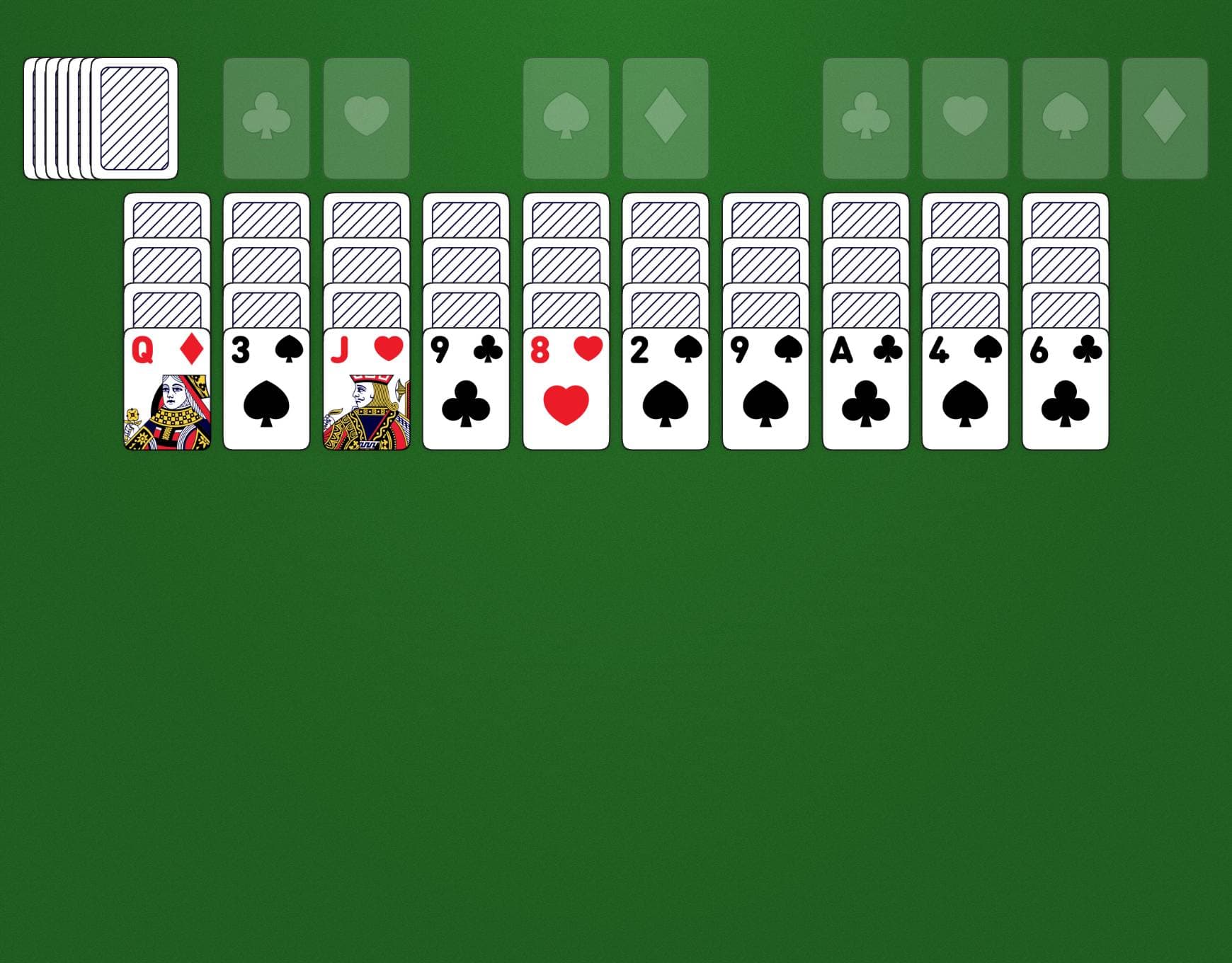
Rouge Forty Solitaire squares off Rouge et Noir's triangular tableau into a tidy rectangle: ten piles of four cards apiece instead of a staircase. Thomas Warfield created it. The game is tough, with just a 15% chance of winning. It's played with two decks, and your result comes down to skill more than luck.
If the tight rectangle here suits you, Rouge et Noir Solitaire gives you the same idea on a looser triangular tableau, and the classic Solitaire strips it down to one deck and a single foundation set.
If you run into anything odd or have an idea that would make the game better, please contact me.
Enjoy yourself!
How to play Rouge Forty Solitaire
Layout:
8 foundation piles: Build the first four piles up in color from Ace to King, then drop complete 13-card alternating-color sequences from the tableau onto the last four.
10 tableau piles: Build down by alternating color. Cards in an alternating-color sequence can be moved as a group. Only a King, or a valid sequence led by a King, may fill an empty space. At the start of the game, each pile is given four cards, with only the top card dealt face-up.
Stock: Clicking the stock deals one card to each tableau pile.
Foundation:
There are eight foundation piles of three kinds.
Foundation A:
Foundation A has two piles, and any ace may be moved to an empty pile in Foundation A. Each pile must start with a different color. A card can be added to a Foundation A pile only if it's one rank higher and the same color as the pile's current top card, so either red King can follow a red Queen — a King of Hearts or a King of Diamonds both work. There can be no more than 13 cards in a pile. The top card of a Foundation A pile can be moved back into play if another pile will accept it.
Foundation B:
Foundation B has two piles, and any ace may be moved to an empty pile in Foundation B. Each pile must start with a different color. A card can be added to a Foundation B pile only if it's one rank higher and the same color as the pile's current top card, so either black 8 can follow a black 7 — an 8 of spades or an 8 of clubs both work. There can be no more than 13 cards in a pile. The top card of a Foundation B pile can be moved back into play if another pile will accept it.
Foundation C:
Foundation C has four piles. Single cards may never be moved to Foundation C. Only once you've built a complete sequence on the tableau, all 13 cards from Ace to King in alternating colors, can you move it to Foundation C as a whole. Cards cannot be moved off Foundation C once they've been placed.
Tableau:
Ten tableau piles of four cards each. The top card in each pile is dealt face-up, and the rest are dealt face-down.
A card can be added to a tableau pile only if it's one rank lower and the opposite color of the pile's current top card, so the only cards that fit on a 4 of spades are the 3 of hearts and 3 of diamonds.
Cards on the tableau that are not covered by another card are free to be played onto the foundation or any other tableau pile.
Only Kings may fill empty spots in the tableau.
If the cards are in alternating red and black order, a run of cards can be shifted together from one tableau column to another.
Stock:
The stock is made up of the leftover cards.
When you click the stock, one card is dealt face-up to the top of each tableau pile.


