Play Streets and Alleys Solitaire Online for Free (No Signup Required)
Every card lies face up from the very first move: dig all four aces out of eight long rows and stack your way to a coin-flip 50% win rate.
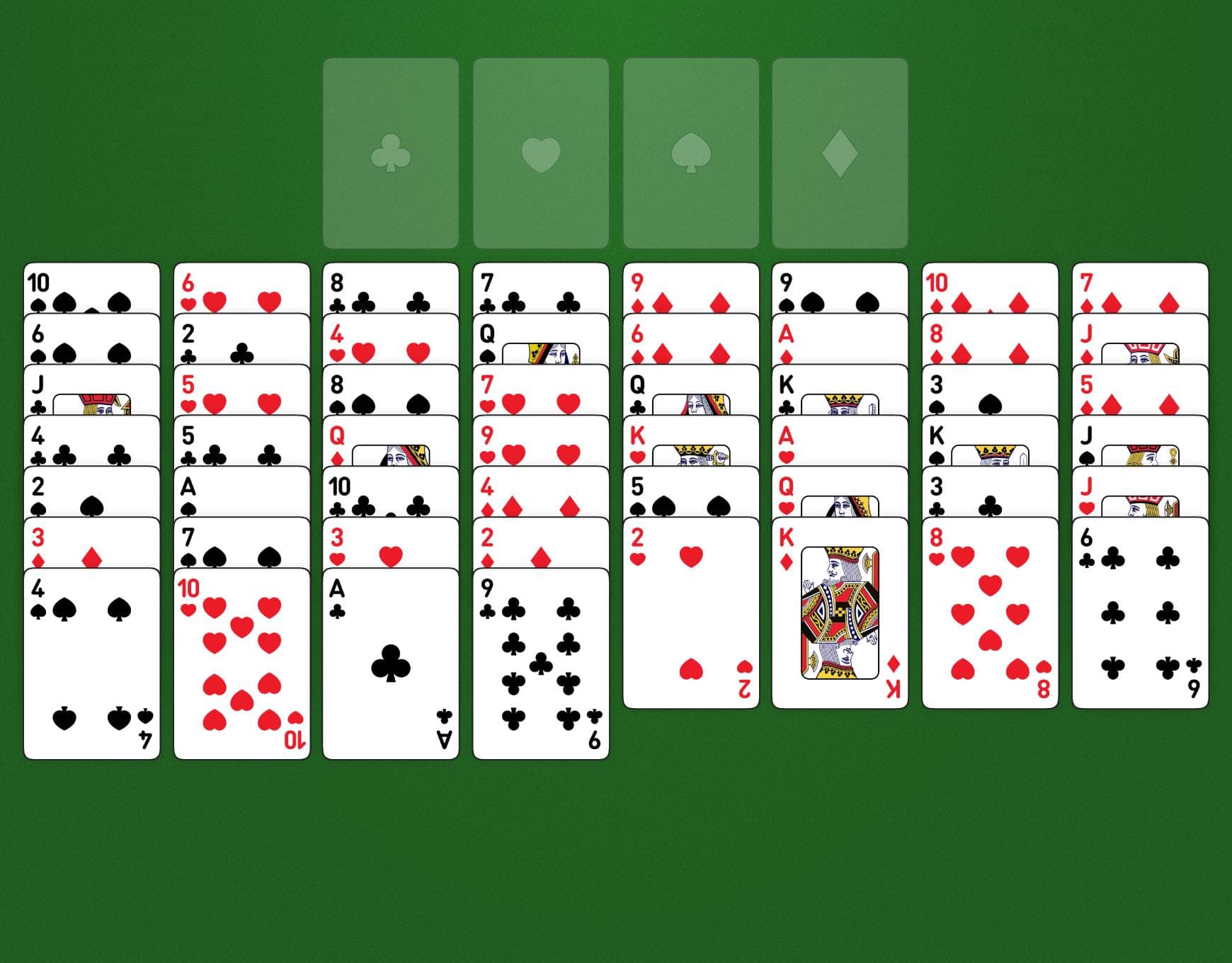
Streets and Alleys Solitaire is one of the oldest "open" solitaires — every card is on the table face-up from the first move, so nothing is hidden and nothing is left to chance once the deal is set. It is essentially Beleaguered Castle without the head start: where Beleaguered Castle hands you the four aces already sitting on their foundations, Streets and Alleys makes you dig them out yourself. The whole deck is dealt into eight long rows flanking four empty foundations, and your task is to untangle the mess one card at a time until every suit has climbed from Ace to King.
Because there is no stock, no waste, and no reserve, every move is a commitment you can see coming. The art is in freeing the aces and low cards buried at the bottoms of the rows without burying something you will need moments later. Empty columns are gold — any card can occupy them — so plan which row you will clear first and resist the urge to spend that space on a card you could have placed elsewhere. Work the longest, most snarled columns early, while you still have room to maneuver.
With roughly 50% of games ending in a win, the difficulty sits at medium. It is played with a single deck, and because every card is visible from the start, winning comes down almost entirely to skill rather than luck.
If you like Streets and Alleys, try Beleaguered Castle Solitaire, the game it's built from, or Stronghold Solitaire, another open, all-face-up cousin. FreeCell scratches a similar itch if you'd rather have reserve cells than empty columns.
If you run into anything odd or have an idea that would make the game better, please contact me.
Enjoy playing!
How to play Streets and Alleys Solitaire
Layout:
4 foundation piles: Build up from Ace to King in the same suit. These piles start empty, so the aces have to be freed from the tableau before you can begin.
8 tableau piles: Build down regardless of suit, moving only one card at a time. Any card may fill an empty column. At the start of the game the whole deck is dealt face-up — the first four piles get seven cards each and the last four get six cards each.
Foundation:
There are four foundation piles, all of which begin empty.
Any ace may be played to a vacant foundation pile as it becomes available.
A card can be added to a foundation pile only if it's one rank higher and the same suit as the pile's current top card, so the only card that fits on a 6 of hearts is a 7 of hearts. There can be no more than 13 cards in a pile.
The top card of each foundation can be moved back into play if another pile will accept it.
Tableau:
Eight tableau piles laid out side by side: four of seven cards and four of six. Every card is dealt face-up.
A card can be added to a tableau pile only if it's one rank lower than the pile's current top card, regardless of suit, so any 7 fits on an 8 of spades.
Cards on the tableau that are not covered by another card are free to be played onto the foundation or any other tableau pile.
Any card can fill an empty slot in the tableau.
Only one card may be moved at a time; sequences are not permitted.


