Play Triple FreeCell Solitaire Online for Free (No Signup Required)
Three decks, ten free cells, thirteen columns, and all 156 cards dealt face-up from your first move. Plan far enough ahead and any deal falls.
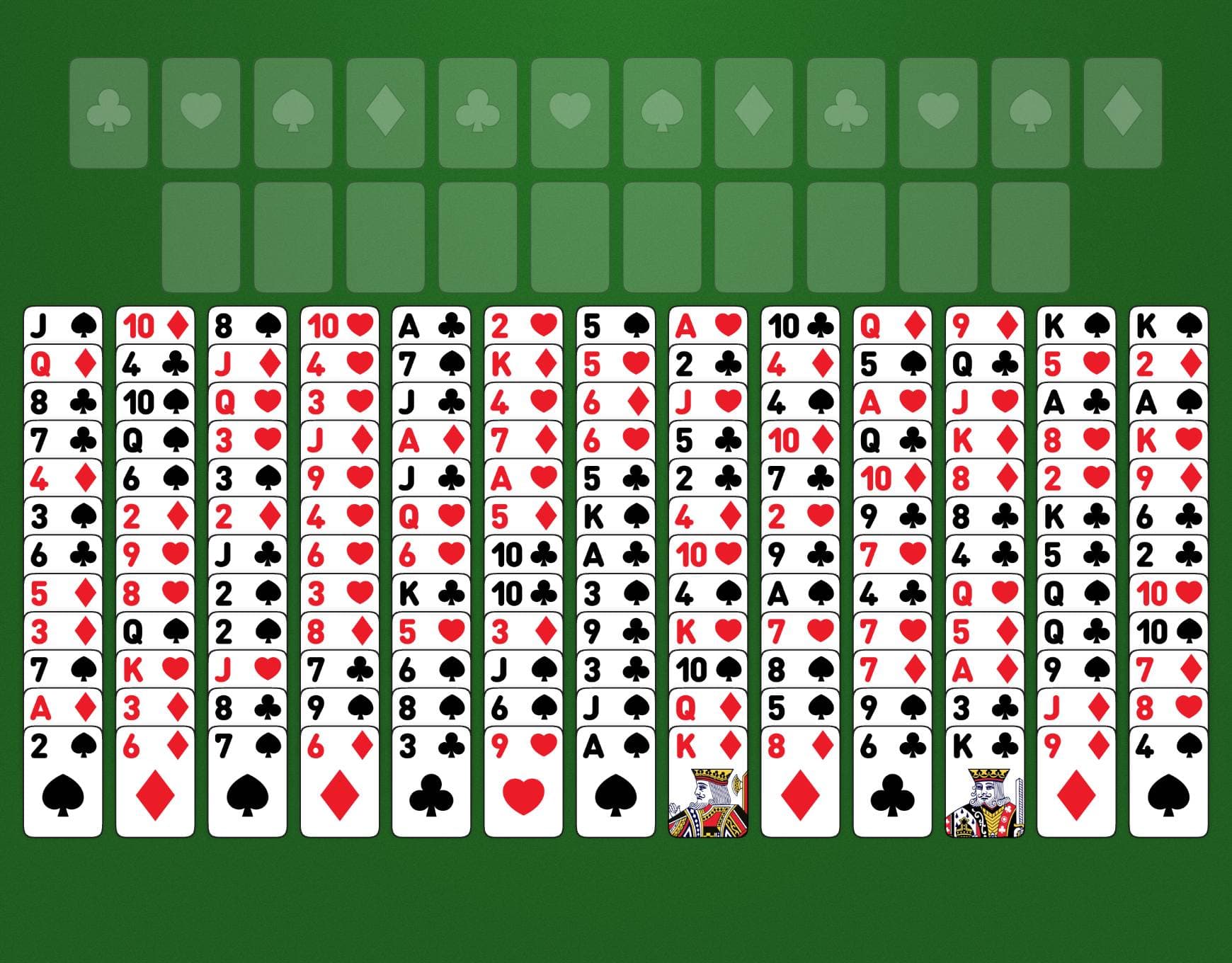
Triple FreeCell Solitaire scales the classic game up to three full decks — 156 cards spread across thirteen columns — while handing you ten free cells to juggle them. Everything is dealt face-up from the very first move, so nothing is hidden. The whole challenge is one of space and sequencing: with the entire board on show, every deal is, in theory, solvable if you plan far enough ahead.
The extra decks change the texture of the game. With three copies of every card in play, the same rank turns up again and again, and stitching together long alternating-color runs is often easier than in single-deck FreeCell. The catch is room to work. Ten cells sound generous, but strung across thirteen deep columns they fill quickly, and a supermove that looks free can swallow every open cell and empty column at once.
The winning habit is to treat the free cells as short-term parking rather than storage. Empty a column as early as you can, because in Triple FreeCell an open tableau pile multiplies the size of the sequences you are able to shift in a single move. Plan the order in which you feed the twelve foundations, too, so that the second and third copy of each Ace is never buried under cards you still need to move.
For more multi-deck FreeCell play, try FreeCell Three Deck Solitaire or Cell Eleven Solitaire. Double FreeCell Solitaire is another good step up from the single-deck game.
If you run into anything odd or have an idea that would make the game better, please contact me.
Enjoy playing!
How to play Triple FreeCell Solitaire
Foundation:
There are twelve foundation piles.
Any Ace may be moved to an empty foundation pile to start it.
A card can be added to a foundation pile only if it's one rank higher and the same suit as the pile's current top card, so the only card that fits on a 4 of spades is a 5 of spades. There can be no more than 13 cards in a pile.
The top card of each foundation can be moved back into play if another pile will accept it.
Cells:
Ten cells, all of which are originally empty.
One card can be stored in each cell. Any available card can be played into any available cell. A card in a cell can be played back to the tableau or the foundation.
Tableau:
Thirteen tableau piles of twelve cards each, every card dealt face-up.
A card can be added to a tableau pile only if it's one rank lower and the opposite color of the pile's current top card, so the only cards that fit on a 6 of hearts are the 5 of spades and 5 of clubs.
Cards on the tableau that are not covered by another card can be played onto the foundation, an empty cell, or any other tableau pile.
Any card can fill an empty slot in the tableau.
Technically, only one card may be moved at a time, but because super-moves are allowed, we will let you move a sequence whenever there are enough empty cells or tableau columns to achieve the same result one card at a time.


